Writing Tools
Manuscript Health Check
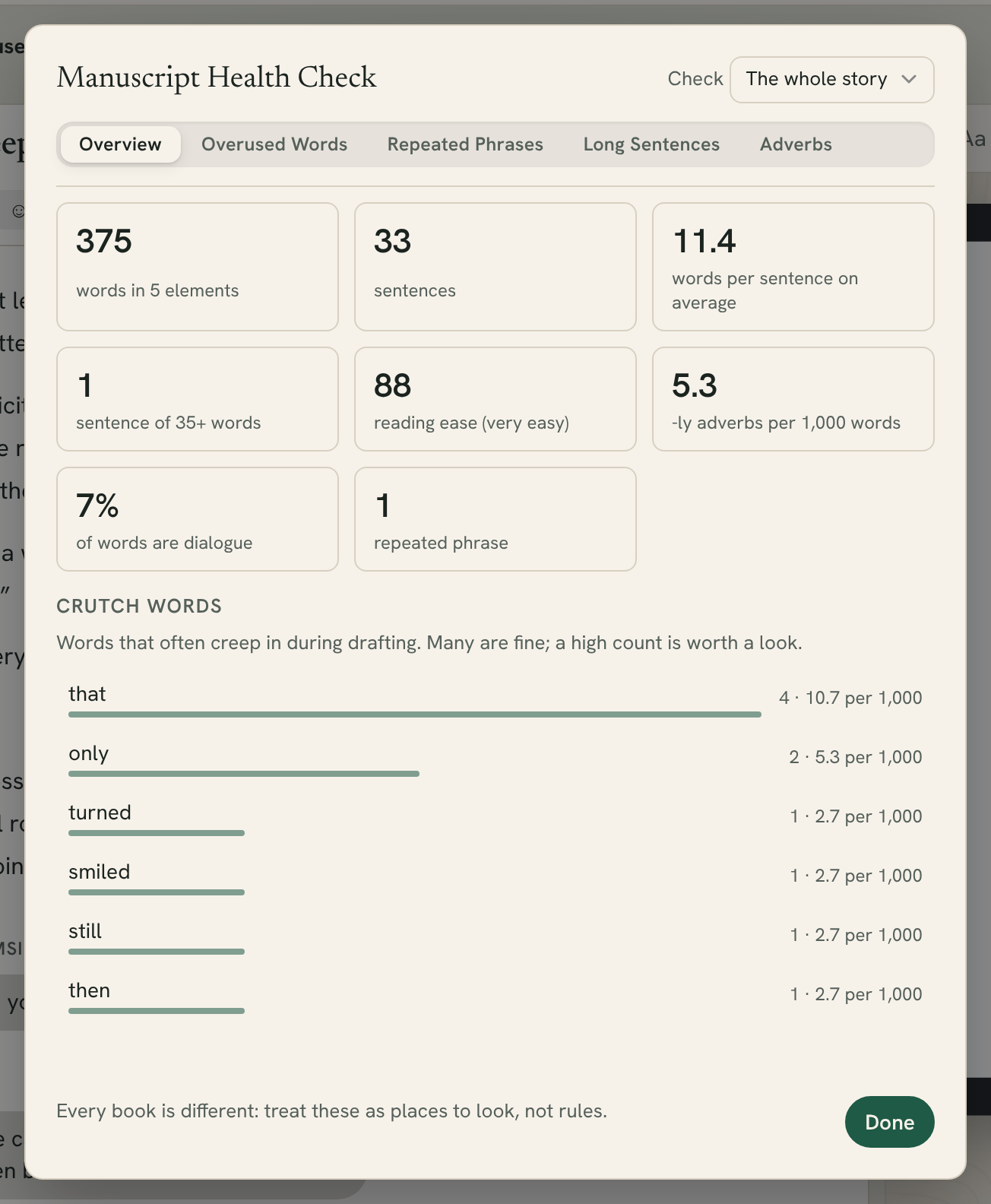
The Manuscript Health Check reads your book and points out things worth a second look: words you use a lot, phrases that echo, very long sentences and more. This article explains each part and how to jump to what it finds.
Every book is different, so treat the results as places to look, not rules. The Health Check only counts and lists. It never changes your text, and it doesn't use AI. See No AI: Your Words Stay Yours.
Running the Health Check
- Choose Edit ▸ Manuscript Health Check….
- At the top right, next to Check, choose The whole story (your chapters, without the front and back matter) or This element (the chapter you're working on).
- Click the tabs to see each part.
- Click Done when you've finished.
Jumping to a result
Click any word, phrase or sentence in the lists. The Health Check closes, and Fleuron opens the find bar on the first place it appears, starting from the chapter it was found in. Use the arrows in the find bar to go on to the next one. See Search Fleuron and Find & Replace.
Overview
The Overview gives you the numbers at a glance:
- words, sentences and the average words per sentence
- how many long sentences there are
- reading ease, with a word such as “plain English” or “fairly hard”
- -ly adverbs per 1,000 words
- how much of your book is dialogue
- how many repeated phrases were found
Below the numbers is a list of Crutch words: words that often creep in while drafting, such as “just”, “really”, “suddenly”, “seemed” and “nodded”. Many are fine. A high count is worth a look.
Overused Words
The words you use most, leaving out everyday words like “the” and “said”. Each shows how many times it appears and how often per 1,000 words. Names usually top the list.
Repeated Phrases
Groups of three to six words that come back again and again. A few are your style; many can feel like an echo to the reader.
Long Sentences
Sentences longer than the length you choose. Pick 25, 30, 35, 40 or 50 words from the menu at the top of the tab. Long sentences can be powerful, but several in a row tire the reader.
Adverbs
Words ending in -ly, with how many of each. Often a stronger verb does the same job (“ran quickly” becomes “raced”).
Note: The word lists, adverbs, crutch words and reading ease are tuned for English. For a book in another language, Fleuron hides the checks that only work in English.
Tip: For checks on how your manuscript came in (missed chapter breaks, straight quotes, double spaces), use File ▸ Check Import…. See Importing Your Manuscript.